
How do businesses survive a crisis?
A balance upended
There are companies within certain sectors that can make a living even on the back of ice. Unfortunately, though, that's not the relative majority in the industries where, for the most part, a decline was seen. But which were the areas where performance dropped?
Let's look at how the different sectors around the world performed during COVID. ContentSquare's comprehensive e-commerce study sets out to show the changes in online traffic caused by the coronavirus, like this:
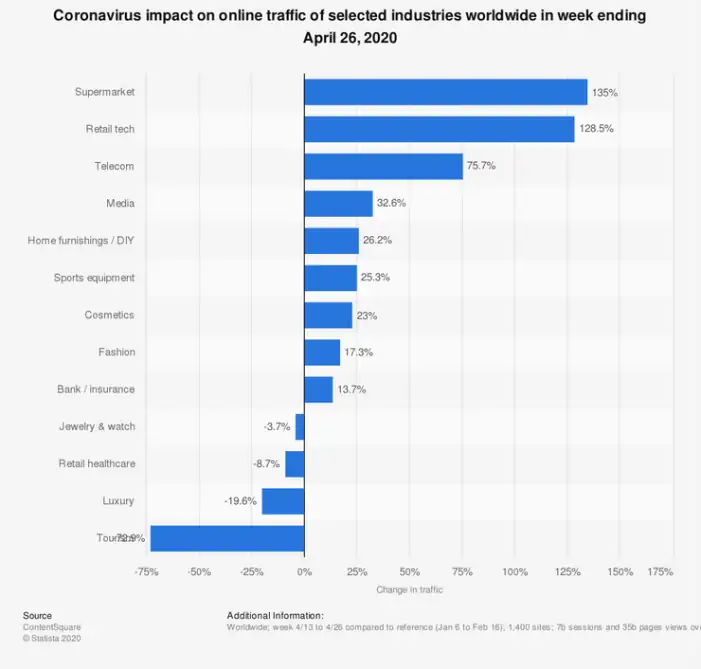
It surely surprises no one in particular that the industry suffering the biggest decline was tourism, with no less than a 72.9% recession in online traffic. Tourism was followed by luxury goods, jewelry and recreational commerce, though the decline in these areas, even combined, didn't reach that of tourism.
Of course, for some areas exactly the opposite of the above is true. A striking 135% traffic increase was seen on the websites of supermarkets that (also) deliver food (e.g. Tesco, Auchan, Kifli.hu), and the traffic of sites selling electronic devices grew by 128.5% too (e.g. Extreme Digital, Media Markt). Interest also rose significantly toward telecom and various media surfaces, but furniture and decor products, as well as sports equipment, also achieved big growth in this period.
And when can we expect the situation to improve?

No one can say for sure. But the question is: what would count as an actual improvement? If restrictions were lifted, would the economy snap back into place as if by magic?
“Abracadabra, if only the crisis would stop!”
Unfortunately the situation isn't that simple. Although I won't draw any grand, deep-reaching conclusions about the future, several experts agree that the consolidation period will likely last several more months even after restrictions are lifted (among others, Loginet also published an article on this).
There are businesses hit harder by the situation than others, which is why adaptation is the key to their survival. But how do these companies adapt, and exactly what strategy do they apply?
Adapting is mandatory!
The ability to adapt, in the classic Darwinian sense, is the key to survival not only for animals in their natural environment, but for businesses too, in our case in a changed economic environment.
The ability to respond adequately and quickly is very important, but opinions are already divided on how to respond. Based on our own experience and that of our clients, we've gathered which strategies and approaches are the ones most businesses apply.
Waiting it out
Many are in a stalemate, because although the crisis has affected them, they can still take either of two directions: they can decide to move forward (with developments, for example), or to proceed cautiously in every decision. In this case, the latter mindset dominates.
Retreating
There were those who were outright forced to cut spending and operate more cost-effectively for a while.
Charging ahead
At many companies business is stagnating right now, orders have dried up, and suddenly a huge amount of workforce capacity has been freed up. There are those who see this period as an opportunity, and instead of minimizing spending (say, with layoffs), they use the "freed-up" time and resources to develop the areas of their business where there may have been gaps, or to solve non-prioritized problems that had been sitting on the To Do list for long months.
Markestic COVID-19 Survey Results
The difference between the three strategies above is striking. The way of responding is of course heavily influenced by which industry we operate in, what sales model we use, and it depends on a whole range of other factors too.
To get a better understanding of the motivation and mindset behind choosing the different methods, Markestic created a survey in which we looked for the answer.
One of the central questions of the survey was what strategy businesses are applying for the next 3–6 months.
As could be anticipated in advance, the majority of respondents (47.22%) apply the principle of cost-cutting and reserve-minded, cautious operation. A quarter of participants said that for now they're waiting it out, while 19% decided to charge ahead and develop their company or focus more on areas neglected until now. Although 8% of respondents saw a rise in traffic, on the whole it can be said that two-thirds of those completing the survey saw a decline.
Another cardinal question of ours concerned how pessimistically businesses view the situation. The question was the following:
“What are you counting on? For how many months will the pandemic make its effect felt in your industry?”
To our surprise, 74% of respondents think the economic effect of the pandemic will be felt in their own industry for less than half a year, and only a quarter of those completing the survey thought the crisis would last longer than that.
Among the answers, the factors most influencing the decline were mostly the following:
- Reduced opening hours
- Change in buying appetite in certain product categories
- Decreased average basket value
- Lack of tourists
- Lack of in-person meetings
- Logistical difficulties, shipping problems (on both the procurement and the sales side)
The fact is that domestic and international restrictions fundamentally changed supply-demand relationships. While demand rose for some product categories (e.g. pharmaceutical products, furniture, household and home decor products), at the same time it fell for others (e.g. passenger cars, flights, accommodation), and on top of that the restrictions placed general procurement and shipping solutions in front of enormous logistical challenges too.
“Looking back on the past, in the area of online marketing what would you place more emphasis on?”
To this question, more than a third of respondents wrote that they would devote more resources to online marketing and to strengthening some form of online presence for their company, or would spend on social media (Facebook, Instagram) and search ads (Google, Bing).
Because of the situation caused by the coronavirus, many businesses were forced to operate exclusively in the online space, and along with that perhaps many are recognizing the potential that lies in digital marketing and in shifting to online operation.
Markestic's strategy
In crisis periods, the silver lining is that individuals and companies alike have to rethink a great many things. Starting with cost structure, everyday process management, business focus, and chosen strategy.
Digital agencies can, of course, choose different strategies too, and did choose them in these weeks.
Probably everyone experienced client loss and contract terminations in this period. At Markestic, we responded to this by charging ahead.
- We doubled down on new business lines so we could help our existing and future partners in more areas. Be that WordPress, email marketing or reporting automation.
- We opened up toward strategic partnerships, with which we aim to cover the areas of expertise we don't have in-house.
- We placed greater focus on foreign projects, to reduce country and exchange-rate risk as much as possible.
- Alongside organic growth, we're focusing more actively on targeted client acquisition. Although many hit the brakes, quite a few also see the way out ahead of them, and are now doubling down on their online presence.
Although Markestic isn't on the list of those who completed the survey, it's perhaps worth mentioning that our team applied the development strategy.
And why did we do so?
We believe in healthy, competence-based competition, and we think the post-crisis period will be even far more competitive than it is now. That's why we concentrated our energy on developments and on perfecting our work so far, so we can provide our partners with an even better and broader service.
Maybe the old chap in the crisps ad was right when he said there's really nothing left of the good old things…?
You could say it's easy to dance when fortune plays your tune. But the businesses that grew owed their growth not only to the changes in demand caused by the crisis, but also to the fact that they secured the right online reach surfaces (a website, a Facebook / Instagram page) and also used search and social ads to drive traffic.
We can see that although there was a decline in some areas and growth in others, it can be stated that (though presumably only temporarily) the industry balance changed completely.
What's also interesting is that the situation prompted businesses to reorganize around digital operation, which is why driving online traffic became crucially important. Although the situation caused by the coronavirus came with a lot of negatives, it did draw attention to the fact that online presence and advertising can be lifesavers in a time of crisis.