
Need an assistant who can help you jot down your racing thoughts while you drive? Need an assistant who takes the load off your call center colleagues and kills the boredom that comes with repetition? We know one, and it's free! If you want the details, stick with us, and by the end of this article you'll be guaranteed to have the finest assistant candidates in hand.
On a more serious note, when our team gathered the top 19 e-commerce trends to expect in 2022 at the start of the year (if you haven't read it yet, head to this link and then come back here), we had to devote two whole points to voice-based solutions. It's already clear that this year will once again be the year of e-commerce, which shows it's worth spending a little longer on the topic.
So let's dive in! Let's find out what's worth knowing about voice assistants and chatbots. We'll explain what a voicebot actually is, and why it's worth putting them to work in e-commerce as soon as possible!
Hey Google, what's a voicebot?
Voice assistants (VUI) first appeared on the endlessly surprising horizon of artificial intelligence around 2017, and today nearly 33% of consumers use voice assistants daily instead of traditional search. No surprise there, since it's a smart, fast and easy-to-use feature, not to mention that it's versatile and works across a range of devices. In fact, thanks to its rise, all kinds of smart devices now come with a voice assistant function, and these are not only able to handle more and more tasks, but are also becoming ever more lifelike. And it's no accident that when it comes to both Apple's and Amazon's assistants, the "ladies" are winning. The results of a study commissioned by Kaspersky, a market-leading cybersecurity company, showed that Hungarian consumers like it when their assistant speaks to them in a female voice, which mirrors global market trends.
Since voice search is growing in popularity, it can directly influence search results and purchase rates. So much so that the total value of purchases made through voice shopping is expected to reach 40 billion dollars (13.3 trillion forints) by 2022, with a 55% increase expected in the number of these users.
Hey Google, when does my next meeting start? Hey Alexa, what's the weather going to be today? Cortana, find me some red shoes. Hey Siri, tell me a joke. It's likely that sentences like these will leave our lips more and more often, because whether it's taking notes while driving, reading the news out loud in the shower or lending a hand in countless other areas, voice assistants are ready and waiting.
And to optimize your e-commerce site, the first thing you need to make sure of is that you've made the site voice-search ready, by prioritizing and updating the questions your customers ask most often. For example:
- company and store information
- shipping and delivery options
- cancellation and return policy
- customer service
- product usage
Plus, for e-commerce stores it's useful if your product search bar works by voice too. And if all that weren't enough, the best part is still to come, because it's great to have a chatbot running on your site, but now it's time for voicebots to help drive your site's traffic too!
Chatbot vs. voicebot
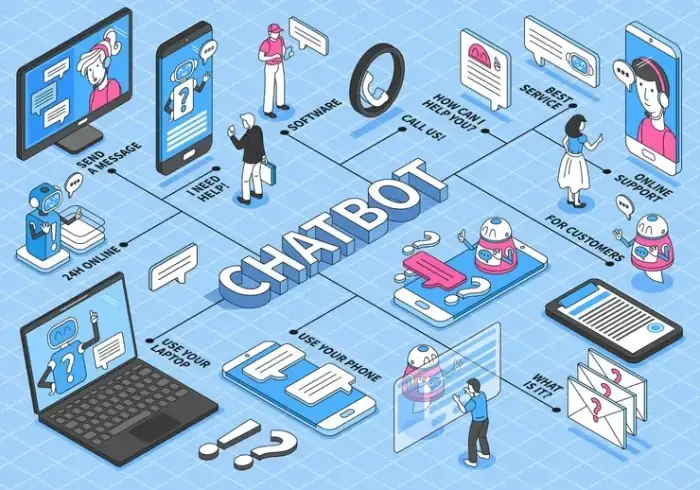
Plenty of people know what a chatbot is, since most users have already come across them, mainly on customer service channels. A chatbot is a computer application that can automatically carry on a conversation with a user. And a voicebot is essentially a chatbot too, only voice-based instead of text-based. While with a chatbot we have to type in our questions and get the answer in writing, a voicebot understands human speech and gives its answer in speech as well. A voicebot is really a voice assistant. And although they debuted back in 1966, and chatbots have developed ever since, in 2011 Siri was the first VUI-capable virtual assistant.
The most important difference is that voicebots require one extra step: human speech has to be recognized and converted into written text. From there, a voicebot essentially behaves just like a chatbot, right up until the answer, which likewise has to be converted back into speech.
The downside of voicebots
➖ A voicebot usually "gets caught" sooner, because the user quickly realizes they're not dealing with a human, since a machine-synthesized voice is recognizable. This negative, however, will disappear entirely within the foreseeable future, because companies' development efforts in this direction are gigantic.
SOLUTION: It's a good idea to make it clear right at the start of the conversation that the information here comes from a machine, so you avoid any suspicion of an intent to deceive.
The benefits of voicebots
➕ A big advantage is that the user's spelling doesn't matter, since you can't misspell anything in spoken language. A recurring problem with chatbots is that many customers communicate with very weak spelling or simply make typos, or don't use accented letters. Chatbots always have to be prepared for these cases with careful training. With voicebots you can skip this step.
➕ It's extremely cost-effective. It's an excellent alternative for call centers. And this isn't about machines taking people's jobs, but much more about the voicebot filtering the customers. It's able to answer 80–90% of the most common customer service questions, and for the rest it still hands the user over to a live agent. That way your colleague doesn't have to spend the day answering the same questions over and over.
➕ They're available 24/7, at night and on holidays too.
➕ They build a database from user questions and enter into proactive interactions, from which plenty of useful conclusions can be drawn later. Bots are able to start conversations and observe how users navigate websites, which means incentives tailored specifically to the customer can be offered.
➕ They save time. Bots represent the new frontier of business. They can automate the tasks that need to be done frequently and at set times, freeing up valuable human work hours so employees can concentrate on other, more pressing matters.
➕ An instant answer with no waiting improves how customers perceive the company. No more listening to Für Elise for hours on end. No more waiting for the lines to free up so you can finally be put through to an agent.
➕ The simple communication process can also improve the conversion rate for e-commerce bots.
➕ They make it easier for a business to expand, since they help you extend your operations to global markets too by handling customers' problems and questions in several languages. On top of that, round-the-clock access means customers can use them regardless of their time zone, so businesses become more accessible to everyone.
Where you can put bots to work
For buyers, it's fundamental to be able to get in touch with the provider or e-commerce site operator instantly and as easily as possible. That's why voice-based solutions further increase customer satisfaction. And the range of use cases is enormous, almost unlimited, and growing at a dazzling pace day by day.
- Taking restaurant orders and table reservations
- Delivering promotions to users
- Marketing campaigns that interact with users
- Market research
- Assistance in webshops
- Handling customer service questions
- Booking theater tickets and flights
- Your solution goes here!
Using bots is highly useful from a marketing angle too. Because…
… we can deliver personalized messages. Just think about it: bots are able to address the consumer by name.
… we can boost engagement. We can offer a direct solution to their problem, based, of course, on the information gathered about them.
… we can collect qualified leads. A lot of valuable time can be saved by having the bot ask predefined qualifying questions during the conversation with the customer, so that later the salesperson approaches the customer with an offer that genuinely interests them.
A good example
Want to give your consumers a personalized experience? By using voicebots and optimizing for voice assistants, this is already within reach. But why stop there and settle for that? Instead, take a page from Burger King, which back in '17, at the debut of Google's VUI, proved that we live in a world of endless possibilities, and it only takes a little creativity to make good use of them.
Click for the video, where the folks at Business Insider show what campaign the Florida-based fast-food chain came up with, and why it was brilliant.
Using chatbots in a company's life clearly increases customer satisfaction. As a result, the number of companies using chatbots is growing exponentially.
At the same time, the growing demand poses serious challenges for the development companies, and it's true that in many areas the technology is still in its infancy. The capital flowing into the industry, however, makes it possible to leave the current shortcomings behind in a short time, opening up new areas of application that we don't even dare to think of yet.
Don't miss out, optimize to deliver a higher-level experience and boost engagement! If you found the thoughts we shared interesting, then read the pieces we've published so far, and become the home-grown emperor of e-commerce!
And if you need help and more information, just say: Hey, (name of your favorite assistant)