In short
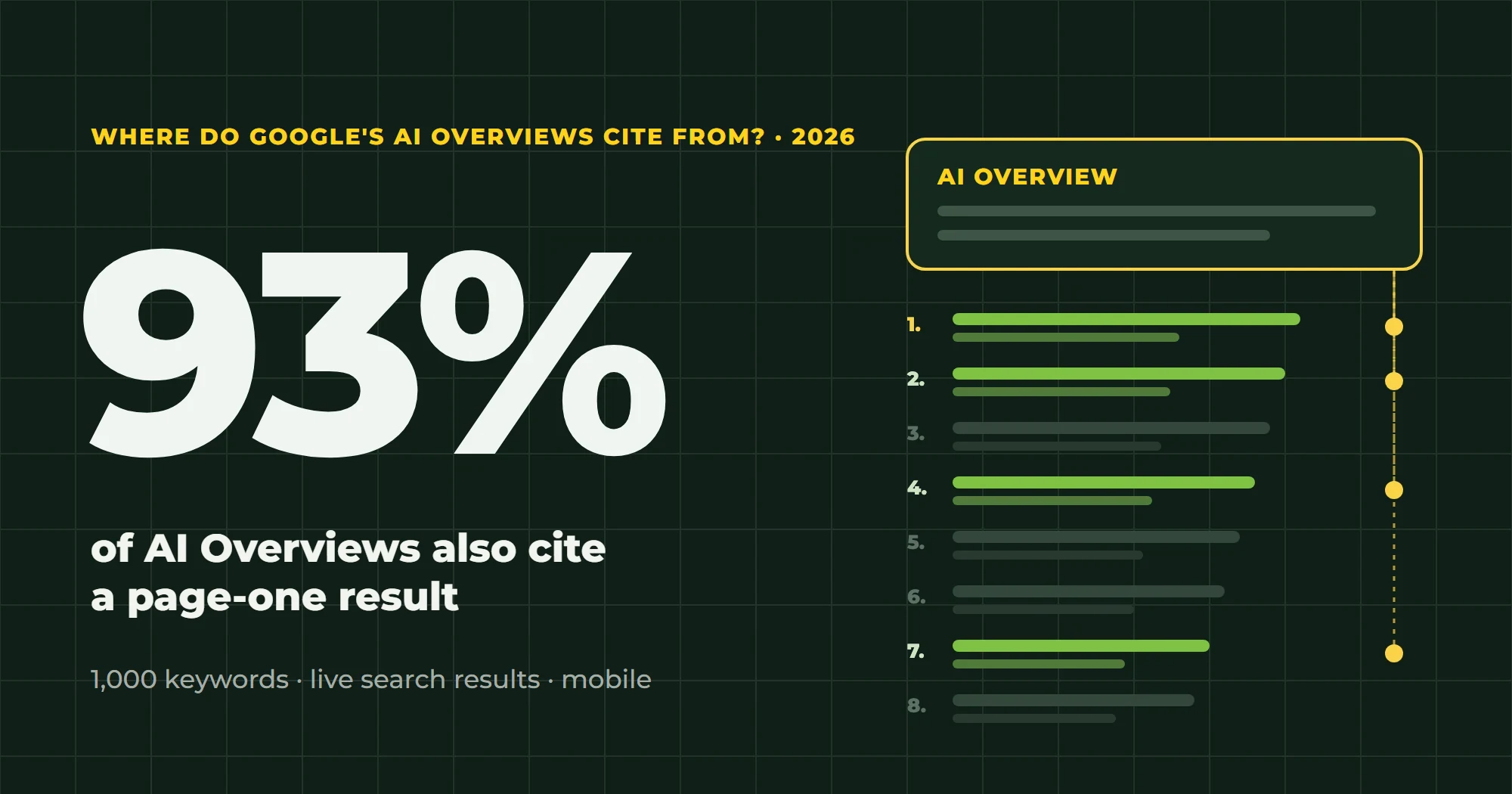
- 93% of AI Overviews cite at least one site that also appears in the top ten classic search results. Only 7% of Overviews have no first-page source at all.
- The AI cites the top-ranking site in 61% of cases, and the site in eighth place still in 39%. Ranking matters, but there's a real chance even at the bottom of the first page.
- The cited page is often not the one that ranks: when the AI cites a first-page site, in roughly one case in four it doesn't cite the ranking page but a different page on the same site.
- Half of all citations point to pages outside the top ten results. On mobile, a large share of these are Google's own Business Profile and Maps data.
Why does this question matter?
On mobile, Google's AI Overview now appears for 72% of the Hungarian keywords we studied, and it's usually the very first element on the search results page (our AI trend report covers this). It's a fair question for a business owner or marketer: if Google answers the query itself, is it still worth working for classic organic rankings? Or does the AI rely on entirely different sources from the ones the results list shows?
To answer it, we compared the two on the same search results page: the AI Overview's citations and the organic results below it. On mobile, an Overview contains 6.9 citations on average, from roughly 5 different sites. So the AI isn't rewriting a single page, it summarizes several at once. The question is: which ones?
The AI draws on the first page
The result is clear: the AI Overview almost always draws on the first page too. On mobile, 93% of Overviews cite at least one site from the classic top ten results, 81% cite one of the top three, and 61% cite the top-ranking site. Desktop looks similar, with slightly different rates: 90%, 78% and 50%.
The takeaway: the first page is almost always among the AI Overview's sources. Classic SEO hasn't lost its value; if anything, it has become the foundation of AI visibility.
What is a ranking worth?
Let's look at it from the results list: how likely is a site to be among the AI Overview's sources, based on its organic ranking?
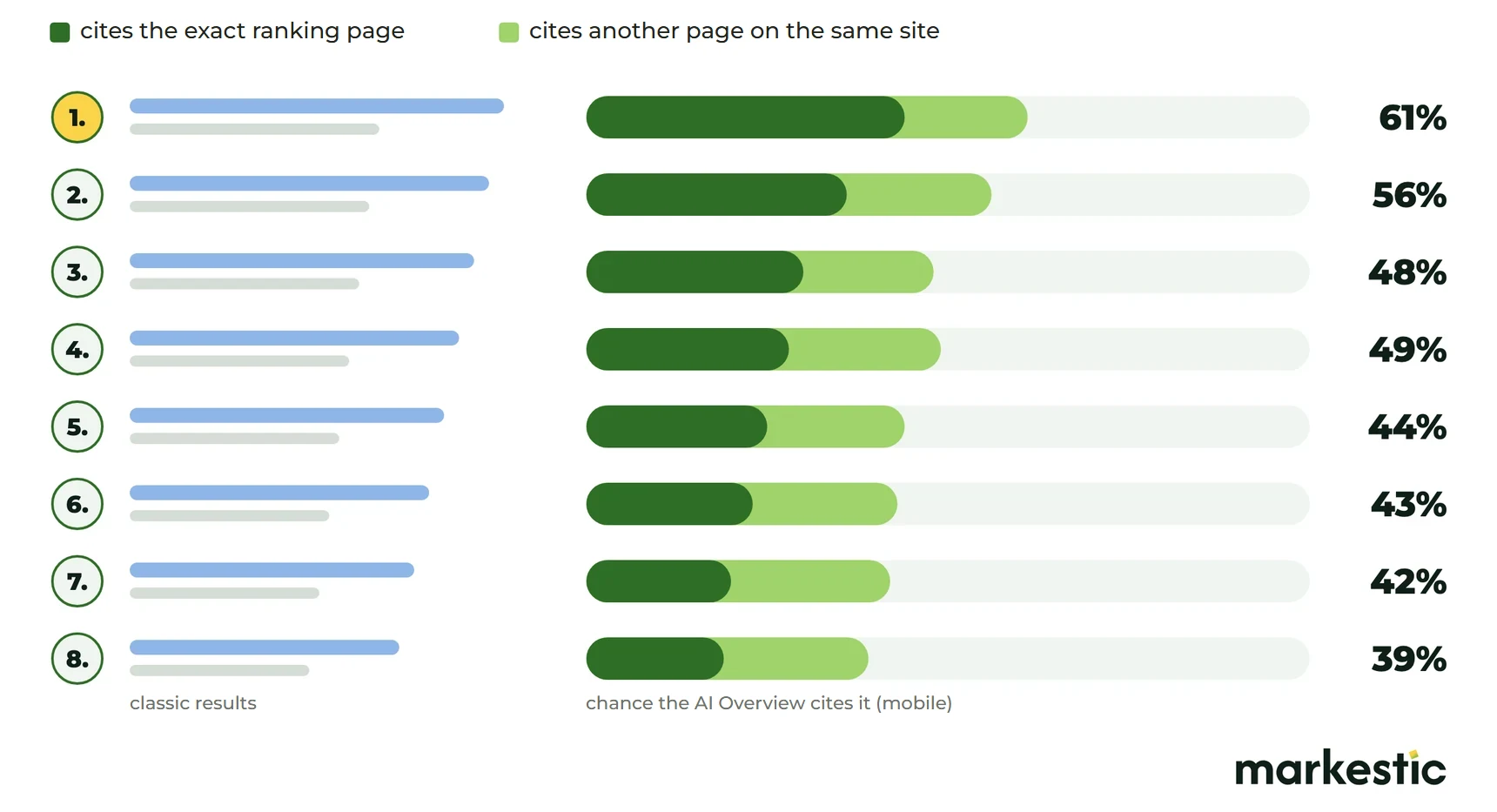
The Overview cites the top-ranking site in 61% of cases, the second in 56%, the third in 48% and the eighth in 39%. The chance declines gradually, but it doesn't vanish at the bottom of the first page: the site in eighth place is still a source in roughly four Overviews out of ten. So the bottom of the first page isn't a lost cause, but moving up still pays off.
It doesn't always cite the page that ranks
The difference between the chart's two colors is a lesson in itself. When the AI cites a site on the first page, 59% of the time it cites the exact page that ranks, but 41% of the time it cites a different page on the same site: a related article, an FAQ page, a category or product page. This suggests Google doesn't just look at the URL, it picks from the site's content as a whole. If a site covers a topic across several pages that build on each other, more than one of its pages has a chance of making it into the Overview's sources.
Yet half the citations come from elsewhere
Counting citations one by one gives a more nuanced picture. On mobile, 13% of citations point to the top-ranking site, 15% to the sites in positions 2 and 3, and 21% to positions 4–10. The other half lead to pages that aren't among the top ten organic results for that search term.
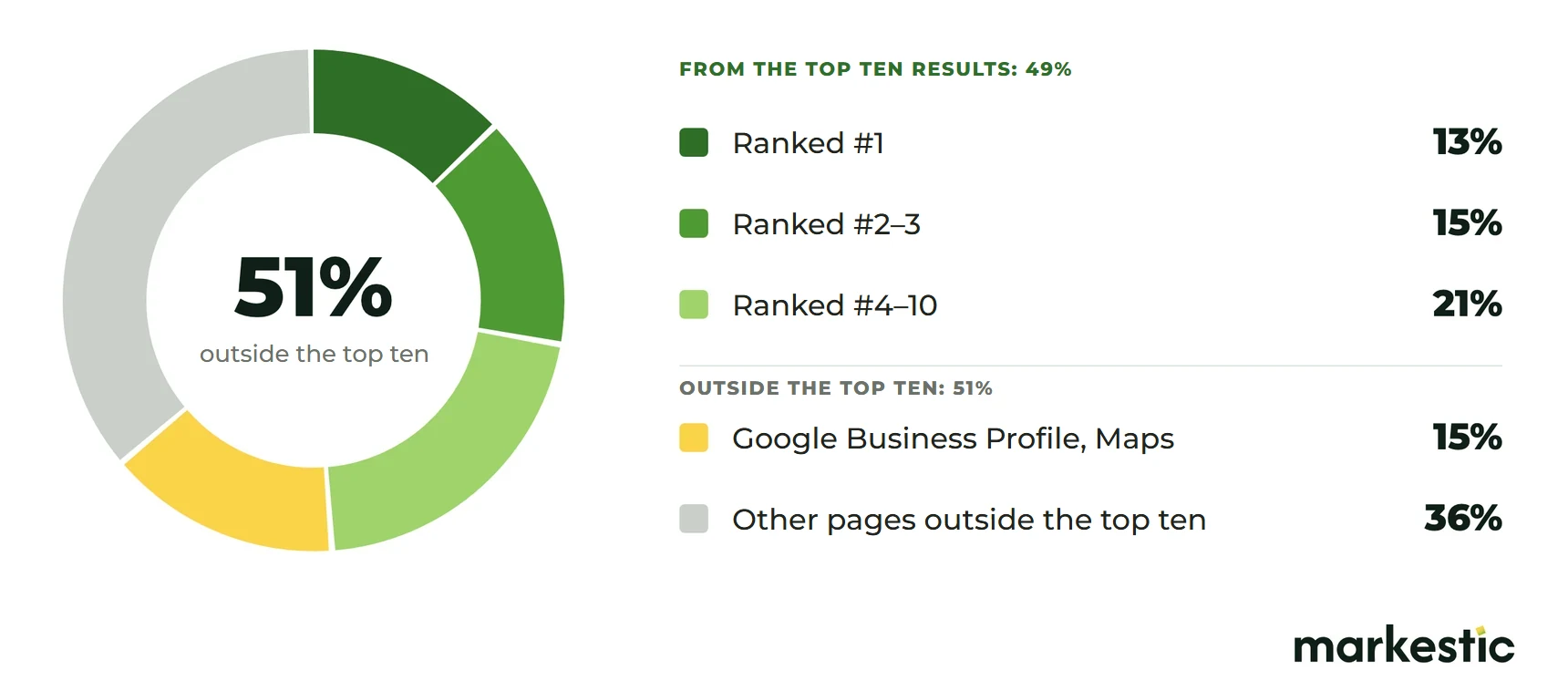
A good quarter of the citations from outside the top ten are Google's own data: Business Profiles, Maps, reviews. This is typical on mobile (15% of citations, versus only 3% on desktop), mainly for local searches: in hospitality, travel and retail. The remaining citations point to sites ranking further down, industry sites, forums and social platforms.
The two findings don't contradict each other. Almost every Overview includes at least one first-page source, but the AI also cites plenty of other pages alongside it. The first page almost always gets in, but it doesn't monopolize the source list.
The link is tighter on mobile, and search intent matters
On mobile, 61% of Overviews cite the top-ranking site, on desktop 50%. Mobile Overviews also list more sources: 6.9 citations on average, versus 5.8 on desktop.
Search intent matters too. When someone searches for a specific brand or website, 67% of Overviews cite the top-ranking site, for searches with purchase intent 65%, but for informational queries only 57%. For "how", "what is" and "why" questions, the AI pieces the answer together from more sources, so the top spot is less of a guaranteed ticket in.
What does this mean in practice?
Organic ranking is the foundation of AI visibility. The vast majority of Overviews draw on the first page too, and the top-ranking result is the one cited most often. If you're working for the first page, you're also working for the AI Overview.
It's not only the top spot that counts. Positions 4–8 aren't a lost cause either: appearances at the bottom of the first page are valuable from an AI perspective too.
Think in terms of the whole website, not just individual pages. The AI often cites a different page on the same site. So if a topic is covered in depth across several interlinked pages, your chances of appearing are even better.
On mobile, your Business Profile is an important source too. For a local business, the details, opening hours and reviews in your Google Business Profile can go straight into the AI answer, so looking after them is now part of AI visibility.
Curious who shows up in the AI Overview for your keywords?
In the Profit Diagnosis we show you how many of your keywords trigger an AI Overview, which sources it cites, and what to do first.
How we measured it
Sample. On 28 October 2026 we pulled the live search results pages for 1,000 Hungarian keywords, on mobile and desktop, with Hungarian language and location settings. The keywords were selected from the keyword sets of 142 Hungarian websites, evenly across 22 topic areas. The comparison covers the search results pages where an AI Overview appeared: 72% of pages on mobile and 68% on desktop.
Matching. We counted an organic result's site as cited if any of the Overview's citations pointed to the same domain (with subdomains merged). For page-level matches, we compared the exact URL.