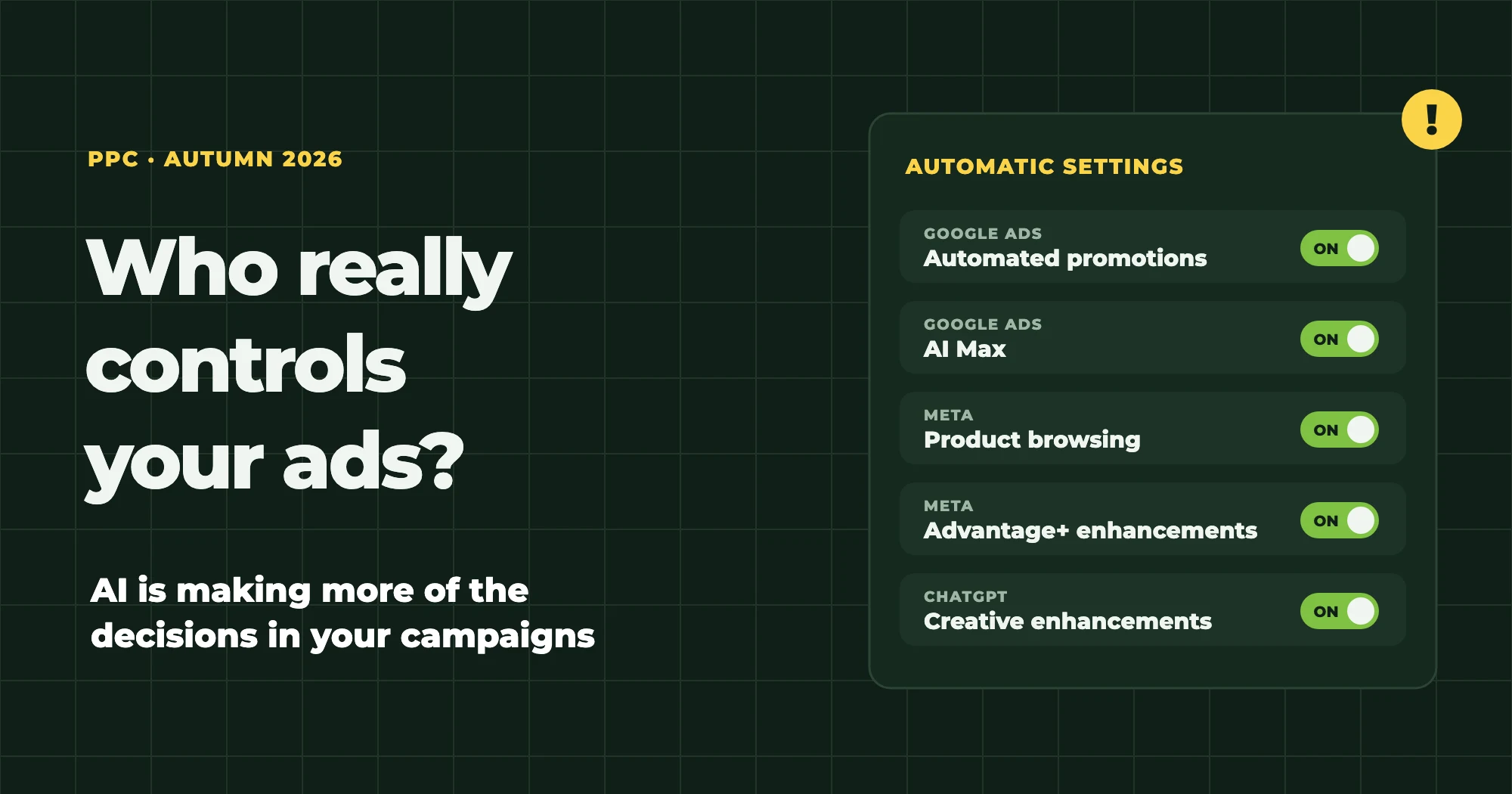
In autumn 2026, though, the platforms introduced or announced several changes that business owners and marketing leaders should know about. Some of them were switched on without asking advertisers at all. If the system changes a campaign by itself, who checks whether that's good for your business? The answer decides whether your marketing budget goes to the right place, and what customers see of your brand.
What has changed, and what's coming
Google and Meta have used AI to support targeting and bidding for years; today it's the backbone of most ad accounts. Now the systems also have a say in which offer a customer sees before the click and which of your pages they land on afterwards.
A few examples of changes that are already live or have been announced:
- From 12 October, Google can automatically show offers it finds on your website next to your ads.
- From 4 December, new Performance Max campaigns will have a feature switched on by default that builds ads from images on your website. Performance Max is Google's automated campaign type that runs across all of Google's channels, including Search, YouTube, Display and Gmail.
- At the end of October, Meta switched on product browsing for ads that were already running. After the click, shoppers first look at the product inside Facebook or Instagram and only then reach your website.
- Ads in ChatGPT have been running in 31 European countries since August. On 30 October, OpenAI switched on automatic rewriting for them, so the system can write new copy, change the image and send visitors to a different landing page without your approval.
Each change looks small on its own. Together, they show how much the platforms now decide on the advertiser's behalf.
Why this is a leadership issue
You don't need to know every new Google Ads or Meta feature. You just need to know who in your company is responsible for keeping an eye on the campaigns.
Say an expired offer is still live on one of your online shop's pages. When Google puts it next to your ad, shoppers see a discount the company no longer wants to give. In another case, the system sends visitors to a different page instead of the carefully chosen landing page. That might even improve results, but if the new page distracts from the offer, you'll get fewer sales.
Your brand's reputation is at stake too
A company selling premium products often deliberately avoids discount-style messaging. For a B2B service provider, it matters that ads don't promise more than the company can deliver. If an AI-written variation overpromises or doesn't sound like your company, it can damage how people see you.
And the responsibility stays with you. Under the new Google Ads terms that took effect on 1 July, reviewing and approving automatically created ads is the advertiser's job. Meta's new terms, which take effect on 20 November 2026, make the advertiser responsible for whatever the platform's AI creates or changes.
Why a good-looking report isn't enough
One of AI's great strengths is that it learns from huge amounts of data. In every single ad auction, Google weighs search intent, the user's device, their location, the time of day and many other signals. No human could keep up with that in real time.
But the system works with what it's given. If the campaign's goal is as many leads as possible, it will bring as many leads as possible. Just because a form submission shows up as a conversion in the report doesn't mean it's worth anything to the business.
Take a B2B company that gets a hundred quote requests a month from its ads. The report says the campaign is doing great, and each lead is getting cheaper. The sales team sees something else. Many leads don't fit the company's ideal customer profile, some come with too small a budget, and others want something the company doesn't offer.
For an online shop, it looks different. Two campaigns can bring in the same revenue for every euro spent on ads, while one sells high-margin products and the other leaves almost no profit. If the weaker campaign spends more and brings in more revenue overall, and you decide based only on the ad platform's numbers, it can easily end up with the bigger budget. That's why it's worth connecting marketing results with sales data: the margin on each product, what a new customer costs and how much they spend with you over time.
A report can mislead the other way too. Sometimes the code that tracks conversions stops working after a website update. The report shows a drop, even though sales may not have fallen at all; the system just can't see them. On top of that, the campaign may spend weeks learning from incomplete data and making worse decisions.
No platform sees the full picture
Google works with data from its own network and Meta with behaviour measured on its own platforms, so neither knows your marketing, sales and goals as a whole.
When Google Ads suddenly shows many more conversions, it looks like good news at first. But some of those buyers may actually have come from Meta ads and only later searched for your company on Google, where they clicked on an ad for your brand name and bought. Or a strong brand-awareness campaign (on TV or social media, say) may have increased searches for your company, and Google is now counting those results as its own.
Say you spend €10,000 a month on online ads and want to increase the budget next quarter. Google would certainly find somewhere to spend the money, and Meta would suggest new audiences. But where would that extra money earn the most? To decide, you need to look at factors such as product profitability, sales team capacity, seasonality and the company's growth goals. Sometimes the next €1,000 really does pay off best in Google Ads; other times Meta, a new channel or improving your existing landing pages brings more.
What to expect from your marketing team or agency
A PPC specialist used to spend most of their time setting up campaigns, adjusting bids and fine-tuning targeting. The platforms now do part of this, so the specialist's job is more about understanding how automated decisions affect the company's results.
A good report goes beyond clicks and conversions. It shows how customer acquisition costs have changed, how good the incoming leads were and how much each channel contributed to revenue.
You can rightly expect the team responsible for marketing to assess the major platform changes and decide, in the company's interest, which ones to keep. If a new automated feature demonstrably brings more customers or revenue, it can stay. If it writes inaccurate messages or sends visitors to the wrong page, it should be restricted.
The advantage comes from the data you give the AI
A small business and a global brand can use the same AI features, so the difference comes from the data and goals the system gets, and the offer and page it sends visitors to. An automated system is very good at finding new leads, but if the offer is weak or the landing page doesn't help people decide, the algorithm can't fix that.
How we handle new features
At Markestic, we use the new AI features too, and we review the ones that switched on by themselves in our clients' accounts. We decide which ones stay based on whether they can be shown to bring more customers or revenue, and wherever possible we look at campaigns together with the client's sales data.
A capable in-house team can also manage campaigns well. Whether it's worth keeping ad management in-house or handing it to an agency mostly depends on your spend and your team's experience.
If it isn't clear which of your campaigns bring real results, or where the money is leaking, fill in our five-minute questionnaire and we'll prepare your Profit Leak Report based on your answers.