In short
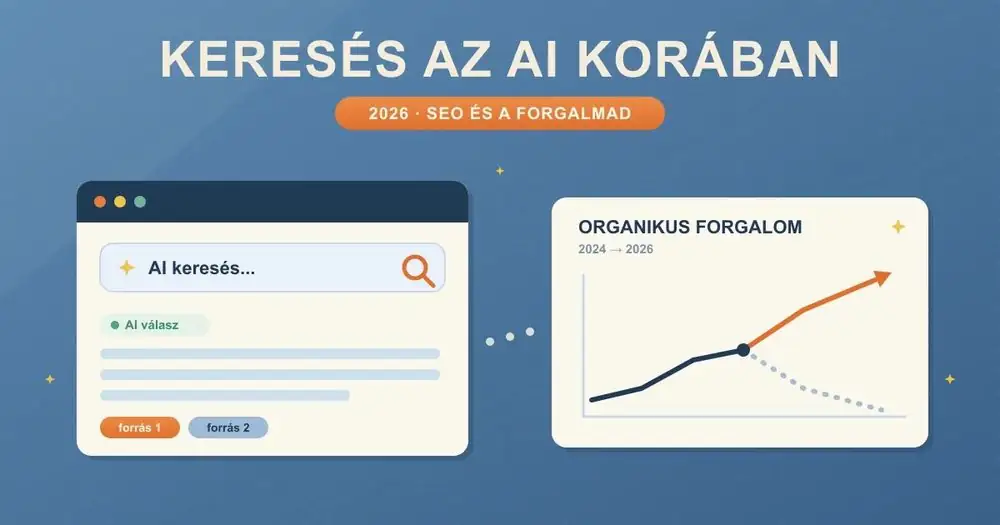
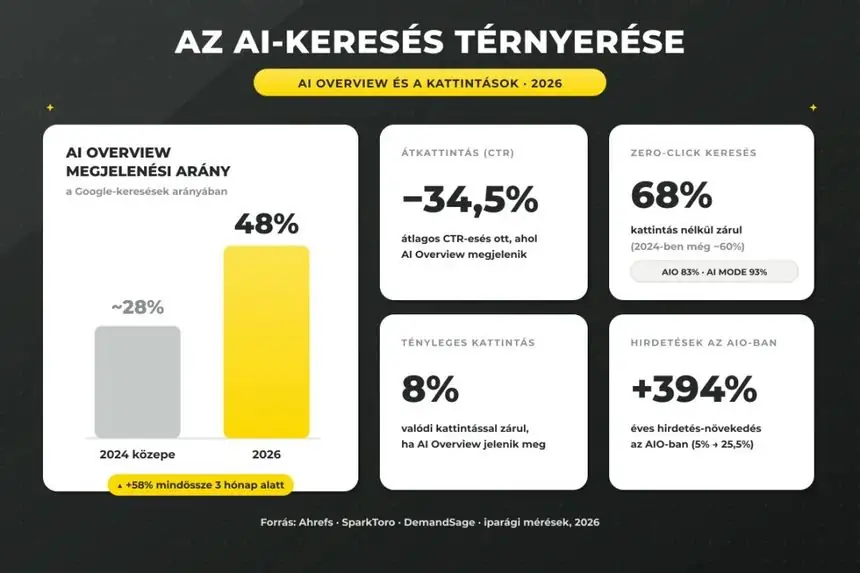
- 48% of Google queries now surface an AI Overview (Ahrefs, March 2026); where it appears, click-through drops by an average of 34.5%.
- It isn't a broad decline but polarization: whoever the AI cites gets roughly 35% more organic clicks, whoever is left out slips down.
- The biggest risk is the measurement blind spot: part of the demand is now captured outside the field of view of traditional SEO reports.
Traffic doesn't disappear evenly: informational content is plunging, e-commerce is more sheltered, and whoever makes it into the AI answer can even receive more than they used to from the top organic position.
The good news is that anyone who has taken SEO seriously until now isn't starting from zero. The bad news is that anyone who doesn't measure this new layer sees an ever smaller slice of the full picture. What follows is an industry snapshot: with fresh data, a platform-by-platform breakdown, and what all of it means strategically for a company.
Buzzword or a real turning point?
Online marketing is full of hot topics, and it's hard to separate the passing fad from what genuinely shapes the years ahead. AI search belongs to the latter category. Not because it's a new technology, but because user behavior is shifting for good: more and more people ask a question in Google's AI mode, or straight into a language model, instead of browsing the classic list of results.
That said, it's worth stripping the hype off it. The work of showing up in AI doesn't break with search optimization. In practice, what makes good SEO usually makes good AI visibility too: the same credible, well-structured content that carries real expertise is what makes it into AI answers, and it's the same content that is strong in the classic results. The difference is subtle but important: new considerations, new metrics, new surfaces, and knowing exactly these is what decides who stays visible. In other words, AI optimization (let's call it that for now, until a term standardizes for it) isn't a system to build from scratch, but an extension of existing search optimization into a new environment. In what follows we'll walk through what has changed in the data, which profession is having the hardest time with it, how the different AI systems make their selection, and where the whole thing is (or may be) heading.
Where does AI search stand in mid-2026?
A few years ago AI summaries popped up only here and there at the top of the results list; today they've become an organic part of search. According to industry measurements, by 2026 Google's AI Overview appears in roughly 47–64% of searches, whereas in mid-2024 it still stood around 25–30%. According to Ahrefs data from March, the AI Overview appearance rate across all Google queries jumped to 48%, a 58% rise over three months compared with 34.5% in December 2025. The process, then, has not only continued but visibly accelerated.
The click side is even harsher. AI Overview pushes CTR down by an average of 34.5% on the searches where it appears, and on informational queries industry analyses measure declines of 30–50%. According to SparkToro's analysis, in the first months of 2026 roughly 68% of Google searches ended without a click, whereas in 2024 that figure was still around 60%. Where AI Overview appears, the no-click rate is already 83%, and in AI Mode it reaches 93%.
Measured from the other side, we see the same thing: according to DemandSage data, only 8% of searches that show an AI summary end in an actual click. In other words, eight or nine out of ten users don't move at all after the AI's answer. Classic organic traffic is shrinking while impressions are often rising at the same time.
There is, however, an important nuance without which the picture would be distorted. Those the AI pulls in and cites end up better off than before. According to SlideFactory's analysis, a page cited from inside an AI Overview gets roughly 35% more organic clicks than it would from a plain first-place ranking, and brands featured in the AI Overview also get 91% more paid clicks than those that don't appear in the summary at all. So this isn't a broad decline but a sharp polarization: whoever makes it into the featured answer doubles down, whoever is left out slips down.
And one more sign that reveals Google's intent: in the first quarter of 2026, ads already appear above AI Overview results in 25.5% of cases, roughly a 394% year-over-year rise compared with about 5% at the start of 2025. So Google is not only pushing organic traffic down, it's also gradually turning its own AI layer into a commercial surface.
Where does all this hurt the most?
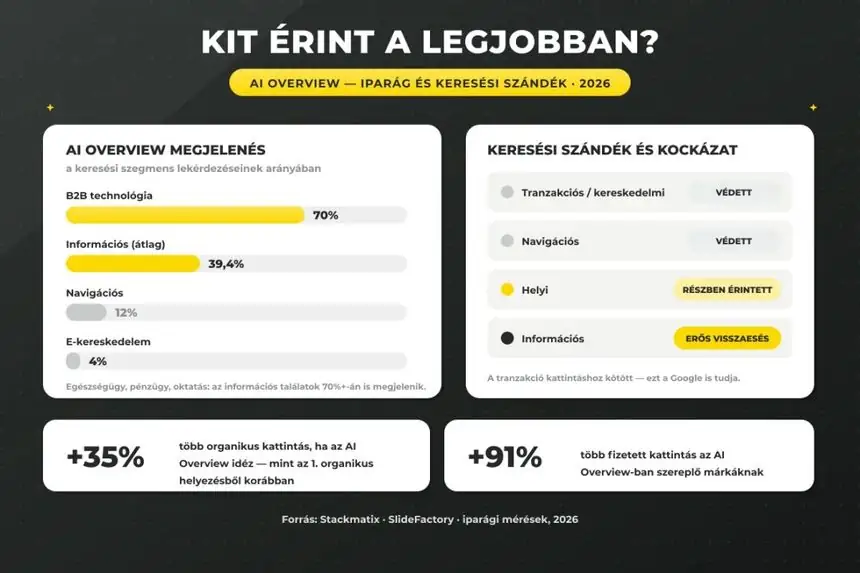
The global averages are misleading, because the differences between industries and search intents are enormous. Informational queries fared worst. According to Stackmatix data, the AI summary appearance rate for B2B tech searches is 70%, while for e-commerce searches it's a mere 4%. That means real protection for webshops, because the transaction is tied to a click in the first place, and Google knows this too.
Navigational queries are similarly protected, with an appearance rate around 12%, compared with 39.4% for informational queries. Someone typing in a brand name usually wants to reach the brand's site, and the system doesn't want to get in the way with two clicks.
The trouble is with explanatory, educational content. In certain segments, health, finance, technology, education, AI Overview appears in over 70% of informational queries. So whoever runs a health advice portal, a finance blog, a SaaS company's education center or a resource that explains software is in the hardest-hit segment. The "what's the best running shoe for long distances" type of article loses readers most visibly, because what used to bring in clicks nicely today, in many cases, only earns an impression on the results list.
Local search is a category of its own, where the picture has so far played out differently. Locally intended queries trigger an AI summary less often, and when they do, the AI typically cites Google Business Profile data and local content. For anyone offering a local service, this is one of the slowest-eroding areas of visibility.
Projected onto the four classic categories of search intent, here's where we stand today: transactional and commercial queries are relatively safe, navigational ones even more so, locally intended ones are partly affected, and informational queries suffer a significant decline. This axis is the first one a company should review its own content portfolio against.
The question behind the search term
Google's decades-old principle is, roughly, to give the best possible answer to the presumed question behind the search term someone typed in. AI search takes this principle to its endpoint. The user no longer has to narrow their thought down to a few keywords; they can ask calmly, in natural language, and the very way the question is phrased carries a great deal of extra information about context and intent. That makes it easier for the system to find "the best answer meant for that person."
The definition of visibility shifts with this. Previously the question was what position you rank in; now it's whether you make it into the handful of sources the AI lifts into its answer at all. On top of that, you have to win this separately across several surfaces with different logics. As voice usage spreads, and as language models become ever more routine, this "I ask, I don't search" behavior will only grow more common. The classic "it's enough to be in the top three results" mindset isn't enough here, because often there aren't even top three results, just one answer.
LLMs as a traffic channel: small, but behaving differently
It's worth treating AI summaries, which have set up shop on Google's results surface, separately from the language models themselves as a standalone traffic channel: the visitors arriving from chatgpt.com, perplexity.ai, Gemini and their peers. The latter is still a low-traffic channel today, but it behaves differently from classic organic, and its growth trajectory means it can't be left out of the planning either.
Let's start with its size, because that's where most of the misunderstanding lies. According to Amsive's analysis, which combed through six months of GA4 data across 54 sites (cited by Search Engine Land), traffic from LLMs accounts for less than 1% of all sessions, while organic search accounts for roughly 32%. So the channel is small for now, and anyone expecting LLM traffic to lift their visitor count today is looking in the wrong place.
On conversion, it's worth nuancing a widespread claim. In the same analysis, organic traffic converted at 4.6% and LLM referral at 4.87%, but the difference did not prove statistically significant on testing. In other words, the "AI traffic converts far better" thesis doesn't hold up as a general rule based on the reliable data available today.
So why bother with it? The most important reason isn't today's volume, but that part of the demand is slipping out of the field of view of traditional measurement. According to Forrester's research, 94% of business buyers use some kind of AI tool while researching. So some of your decision-maker customers today form an opinion about you, or about your competitor, before they ever open your website. This traffic hasn't "disappeared," it has just moved to a surface your usual measurements can't see. And in a no-click world, appearing in the AI answer is often the only brand touchpoint, even if it never turns into a click.
How do AI search engines choose their sources?
Anyone who wants to respond meaningfully needs to understand the logic by which each system makes its selection. Here's the first lesson: there is no single AI search. AI Overview, AI Mode, Gemini, ChatGPT, Perplexity, Copilot and Claude all relate to the web differently, and anyone who tries to cover all of them with a single recipe won't be strong at any of them.
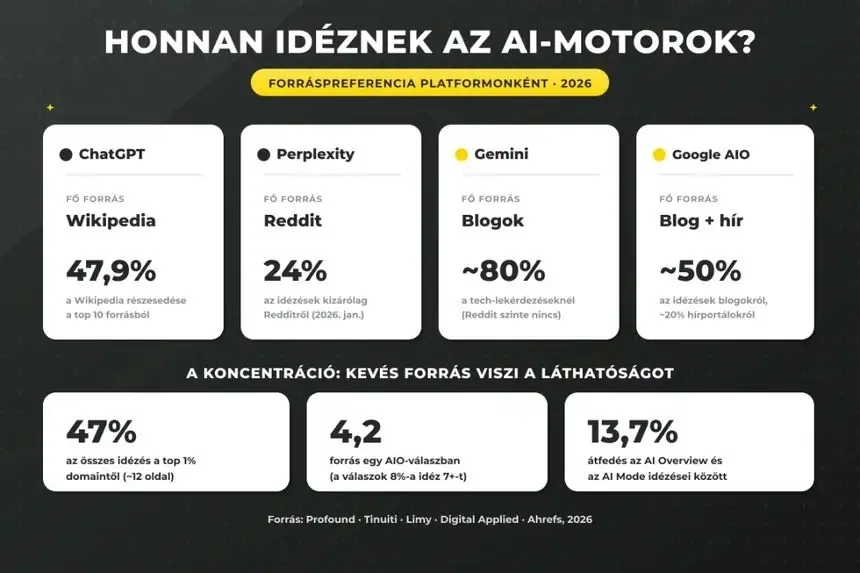
According to Profound's analysis, Wikipedia provides 7.8% of ChatGPT's citations, and among the top 10 sources Wikipedia's share is close to 47.9%. ChatGPT prefers factual, collectively edited reference content. Perplexity is quite different: 6.6% of its citations come from Reddit, three and a half times what's measured at ChatGPT, and according to Tinuiti's January 2026 data, in a single month 24% of Perplexity citations came exclusively from Reddit, which suggests it weights community, experience-based discussion. Gemini is more distinctive still: according to Limy's analysis, for tech-sector queries close to 80% of its citations come from blogs, while Reddit practically doesn't appear.
Google AI Overview settles onto a middle path: according to ALM Corp data, 2.2% of citations come from Reddit and 1.9% from YouTube, and the top 10 is filled by sites like Gartner, NerdWallet, Forbes, Wikipedia and Medium. The full map, however, is more complex: close to half of citations come from blogs and about 20% from news portals. That's good news for professional blogs operating in the Hungarian market: you don't have to be a giant publisher to make it among the sources the AI cites.
All of this is strongly influenced by concentration. According to Digital Applied's study analyzing 1,000 AI Overviews, the top 1% of the most frequently cited domains, roughly 12 sites including Wikipedia, Reddit, Forbes, Healthline and the New York Times, account for 47% of all citations. According to the 5W report, the top 15 domains carry 68% of all consolidated AI citations. And the whole ecosystem rests on one hard fact: according to Digital Applied, an AI Overview cites an average of 4.2 sources, and only 8% of answers cite more than 7 sources. So the game revolves around four spots, and whoever doesn't fit in doesn't exist in the answer. On top of that, according to Ahrefs' December 2025 data, there's only a 13.7% overlap between AI Overview and AI Mode citations, meaning that on the same query the two Google surfaces call up practically different sources.
The logic of AI Mode and the new results surface
Google AI Mode essentially replaces the classic list of blue links with a chat-like surface, where as a user you get a summarized answer, and the sources appear either as citations, or not at all. The classic "let's scroll down" option simply doesn't exist here. The formula is blunt: you're either in the answer, or invisible. According to RankZ data, AI Mode answers contain an average of 12.6 links, and AI Overview cites 13.3 sources per answer. There's more room, but the basic principle is the same.
The scale is hard to underestimate. In 2026 ChatGPT has 800 million weekly active users, and Perplexity handles roughly 780 million queries a month. According to Forrester's research, twice as many business buyers named generative AI a more valuable source of information than vendors' websites or sales colleagues. Tinuiti also documents a particularly important pattern: Google deliberately doesn't sync its surfaces. By January, AI Mode was already citing 243% of AI Overview's unique domains, and Gemini had moved to 112%. So Google is building three citation maps across three surfaces, and recalibrating them from time to time. Anyone trying to build a universal "Google AI strategy" in 2026 will surely lose.
Where is all this heading, and what should we prepare for?
Here it's worth staying level-headed, because the outcome is far from decided. A few forces that will shape the coming years.
Google's data advantage hasn't disappeared. No one sits on a larger, more structured search database, and by its very nature artificial intelligence is far, far stronger at data processing than at chatting. So the contest isn't necessarily about whether ChatGPT "defeats" the search engine, it's much more about search itself becoming a conversation.
Meanwhile a tough legal front is opening over what language models may use, and how they're obliged to attribute the source. The outcome of this will meaningfully affect whose content will be worth how much in AI answers. And there's the noise: the amount of AI-generated content on the web is growing exponentially, to such a degree that the concept of "originality" may be revalued in the short term, or at least won't mean what it means today. And a few years out, part of the tasks we solve with search today may turn into communication between agents…
You can't prepare for these with a single ready-made recipe. But you can prepare for a company not betting everything on a single metric of a single channel, and for having visibility into what's happening to it on these new surfaces.
E-E-A-T and brand signals: the mathematics of credibility
E-E-A-T (Experience, Expertise, Authoritativeness, Trustworthiness) used to be more of a quality guideline, but today it works as a ranking and AI-visibility filter. Search engines have to contend with vast amounts of AI content produced quickly and cheaply, and they need a reliable method to decide what deserves visibility and citation. According to ClickRank, this filtering today is clearly driven by the evaluation of E-E-A-T signals.
The most concrete place where this shows up is the author. Google's AI Overview system strongly prefers pages with identifiable author verification, original data and structured markup. An article with no author increasingly struggles to make it into the featured answers, because it doesn't give the algorithm enough to hold onto. You can dig as deep here as the knowsAbout schema, available since the March 2026 core update, with which an organization and its authors can declare the topics they credibly own.
The other layer of credibility is the number of brand mentions. And here comes perhaps the single most important data point in this piece: according to Ahrefs' analysis of 75,000 brands, brand-name mentions show a 0.664 correlation with AI search visibility, while for classic backlinks that value is only 0.218. So brand mentions move together with AI visibility three times more strongly. In the same study, the correlation between sheer content volume and AI visibility is a mere 0.19. In other words, the "we'll write more articles" strategy on its own barely moves the needle, while "let us be mentioned more often in credible places" does. Edelman's study adds to this: 90% of the AI citations that determine online visibility come from earned and owned media, only a fraction from paid placements.
The new mathematics of link building and digital PR
Perhaps the deepest realignment has happened in link building. The "the more backlinks, the better" recipe no longer delivers its old result. According to Semola Digital, the secondary effect of the March 2026 link spam update was to raise the relative value of credible media coverage. According to Reporter Outreach data, an editorial link from a credible publisher is worth more today than 50 directory links, because Google's systems value the editorial decision behind the link.
The even more interesting pattern concerns link-free brand mentions. If a brand name appears in a credible article in the right professional context, AI systems record it even when it isn't there as a link: the entity co-reference signals record the joint mention of the domain and the field on their knowledge map. A brand that frequently appears alongside given industry concepts slowly builds itself into the category's natural map of references.
One data point that shows the whole direction: in mid-2025, roughly 76% of pages cited by AI also appeared among Google's top 10 organic results; by early 2026 that share had fallen to roughly 38%. So the AI increasingly chooses its own sources, and increasingly less from the traditional top ten results.
New success metrics and the limits of measurement
The most significant change in measurement is that traffic on its own no longer describes visibility. A well-built picture of visibility today has at least four layers: classic organic traffic and Search Console data; AI citation across the various surfaces; the tracking of brand mentions.
Here, though, we have to be honest about the limits of measurement, because this doesn't work like tracking keyword positions. Classic rank-tracking software assigns one position to one keyword; in AI search there is no such position. A language model gives a different answer to the same question depending on wording, context and personalization. What can be measured isn't position, but how many times and in what context the model mentions or cites you for a set of questions you provide. This is inevitably sampling: you can run only a small fraction of the possible questions, and from that you infer visibility.
That's exactly what the tools specialized for this do. Otterly, for example, regularly runs a user-defined set of prompts against ChatGPT, Perplexity, Google AI Overview and AI Mode, Gemini and Copilot, as a neutral user, and records whether your brand appeared, whether your page was cited, and how you stand relative to competitors.
SE Ranking's AI tools show, for the keywords you track, when an AI Overview appears and which URLs Google lifts into the answer, alongside the classic SERP positions. Both are useful, but neither gives a "ranking" in the old sense of the word: they give a mention or citation rate measured on a sample, which is worth viewing as a trend, not as absolute truth.
Where this becomes measurable
The "be in the answer" principle is only worth something if you can also see where you stand. Meanwhile the market has a staggering number of "AI tools," and most of them aren't worth much on their own. Partly because of the measurement limits mentioned above, partly because none of them decides on its own what's even worth measuring: which questions, alongside which competitors, and how the resulting data should be interpreted. The difference isn't in the tool, but in what we ask of it and what we do with the answer: which queries are relevant, who the real competitors are, and what the numbers mean in the given business situation. We know that not every route leads to the goal, partly because we've walked down a few dead ends ourselves before reaching a result you can build on.
The tangible outcome of this approach is our AI visibility audit. For example, we carried out one such comprehensive audit for a healthcare provider client: we measured the brand's presence across both Google's AI surfaces (AI Overview and AI Mode) and the conversational language models (ChatGPT, Perplexity, Copilot, Google), across nearly five hundred queries, plus a set of 45 questions run daily across four engines over three weeks, which on its own meant more than 26,000 AI citations, benchmarked against ten competitors. This was complemented by a page-level, 70-point AI readiness score across seven dimensions, and a prioritized, twelve-month roadmap with a built-in re-measurement point. Not a presentation chart, but a measurable starting point: exactly the kind of material a leader can make a decision from.
What does this mean at the decision-maker level?
The most important shift is one of mindset. A company can be in a stable position, with rising impressions, while its actual visitor count declines. This isn't an error in the report, it's the new normal. Two things follow from this: you have to think holistically, not in silos. Organic search, AI surfaces, brand mentions and paid placements today form one interconnected system. Two: you can't manage what you can't see. If your report is completely blind to the AI surfaces, then you have no information about an ever-larger slice of demand.
The realignment of search won't be settled tomorrow, and it isn't a single big project either. But the starting point is the same for everyone: knowing where you stand today. If you're curious how your brand shows up on Google's AI surfaces and in the language models, and where your competitor is ahead of you, we can show you concretely with an AI visibility audit. And in an upcoming piece, for our subscribers, we'll go through the practices worth introducing if you want not just to see this visibility, but to improve it too, from citation-ready content through digital PR to structured data.
Sources
- Ahrefs – AI Overview appearance rate, brand-mention and link correlation, AIO/AI Mode overlap (cited)reporteroutreach.com →
- SlideFactory – CTR impact, polarization, ads in the AI Overview, paid clickstheslidefactory.com →
- eSEOspace – AI Overview appearance rates, informational querieseseospace.com →
- SEO.com – AI Mode, publisher traffic lossseo.com →
- DemandSage – AI Overview click ratedemandsage.com →
- SparkToro – zero-click searches 2026sparktoro.com →
- Digital Applied – zero-click breakdown; 1000 AI Overview citation analysisdigitalapplied.com →
- Stackmatix – breakdown by sector and search intentstackmatix.com →
- Amsive / Search Engine Land – LLM traffic volume and conversionsearchengineland.com →
- Forrester (cited by: Atomicagi) – B2B buyers' AI usageatomicagi.com →
- Profound – ChatGPT citation patternstryprofound.com →
- ALM Corp – Perplexity and AI Overview citation patternsalmcorp.com →
- Limy – Gemini source distributionlimy.ai →
- PR Newswire (5W) – citation concentration, top domainsprnewswire.com →
- RankZ – AI Mode/AI Overview link and source countrankz.co →
- Tinuiti – cross-surface citation divergencetinuiti.com →
- ClickRank – E-E-A-T and AIclickrank.ai →
- Semola Digital – link spam update, digital PRsemoladigita.com →
- BuzzStream (cited by: Rank Like A Hero) – tracking AI citationsheroicrankings.com →
Where does your brand stand in AI answers?
In an AI visibility audit we show you concretely: for which questions you show up, where your competitor is ahead, and what to fix first.